
Differences Between Bus, Ring & Star Topologies
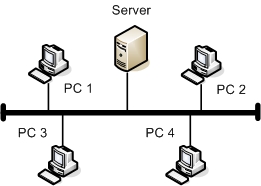
Figure below shows the bus topology architecture
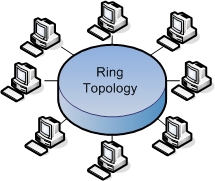
In a Ring topology every device/node is connected to exactly two other nodes one on either side of it in closed loop fashion. All messages travel though the ring either in a clockwise direction or anti-clockwise direction. Ring topology is very rarely used today because they are expensive, difficult to install and manage. A failure in any single connection disrupts the ring topology thus also making ring topology a rare choice for network topologies.
Figure below shows the ring topology architecture
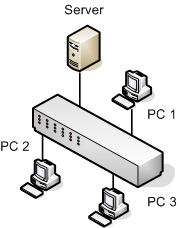
Star topology is the most common topology and is the widely implemented. In a Star Topology every device is connected to a central device such as a switch. Star topology requires more cable as compared to other topologies but it mode robust as a failure in one cable will only disconnect the specific connected computer via that cable to the central device. The messages between systems will always flow via the central device and so if the central device fails the entire network will fail. Star topology is very easy install, manage and troubleshoot making it the most common topology in home and office networks.
Figure below shows the star topology architecture
Difference Between LAN, MAN and WAN
The Network allows computers to connect and communicate with different computers via any medium. LAN, MAN, and WAN are the three types of the network designed to operate over the area they cover. There are some similarities and dissimilarities between them. One of the major differences is the geographical area they cover, i.e. LAN covers the smallest area; MAN covers an area larger than LAN and WAN comprises the largest of all.
| BASIS OF COMPARISON | LAN | MAN | WAN |
|---|---|---|---|
| Expands to | Local Area Network | Metropolitan Area Network | Wide Area Network |
| Meaning | A network that connects a group of computers in a small geographical area. | It covers relatively large region such as cities, towns. | It spans large locality and connects countries together. Example Internet. |
| Ownership of Network | Private | Private or Public | Private or Public |
| Design and maintenance | Easy | Difficult | Difficult |
| Propagation Delay | Short | Moderate | Long |
| Speed | High | Moderate | Low |
| Fault Tolerance | More Tolerant | Less Tolerant | Less Tolerant |
| Congestion | Less | More | More |
| Used for | College, School, Hospital. | Small towns, City. | Country/Continent. |
Definition of Local Area Network
LAN or Local Area Network links network devices in such a way that personal computer and workstations can share data, tools and programs. Data transmits at a very fast rate as the number of computers linked are limited. LAN’s cover smaller geographical area and are privately owned. One can use it for an office building, home, hospital, schools, etc. LAN is easy to design and maintain.
Definition of Metropolitan Area Network
MAN or Metropolitan area Network covers a larger area than that of a LAN and smaller area as compared to WAN. It connects two or more computers that are apart but resides in the same or different cities. It covers a large geographical area and may serve as an ISP (Internet Service Provider). It’s hard to design and maintain a Metropolitan Area Network.
Definition of Wide Area Network
WAN or Wide Area Network is a computer network that extends over a large geographical area. A WAN could be a connection of LAN connecting to other LAN’s via telephone lines and radio waves.

No comments:
Post a Comment